Description
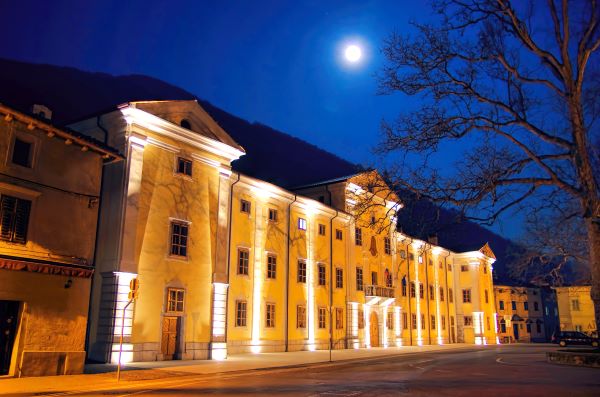
The greatest artistic gem in Vipava is the Lanthieri Palace, which was probably built on the former fortified surrounding area (economic and administrative centre) of the Lower Vipava Castle. The Lanthieris, already in their third generation of residence in Carniola and their second generation of residence in Gorizia, acquired this strategic and rich landholding from the provincial ruler, located not far from the border of two Habsburg provinces.
The estate changed hands frequently in the past. It probably came into the possession of the Flachenfeld family shortly after 1691; Baron Lorenz Flachenfeld sold it to Jurij Anton Radovič on 1 November 1758. The estate did not become the property of the Counts of Lanthieri until 1858, when they also repurposed it as a wine- and fruit-growing school.
As the building was the family’s residential palace, it had to reflect their wealth, education, and prestige, so shortly after the Lanthieri family finally bought the domain after decades of management, they began construction of a new mansion. The building complex was probably originally designed on an L-shaped plan, with two elongated wings. The main façade faced the village square (plac), while the side façade followed one of the village streets.
The Baroque Lanthieri Mansion on today’s main square has its rear side leaning against the largest spring of the Vipava River. The mansion impresses not only with its dimensions but also with its mighty façade, marked by a balcony with a balustrade resting on stone consoles, above which is the coat of arms of the Lanthieri family. In the middle of the façade there is also a simple semicircular portal, through which one enters under an arched passage into the inner courtyard. The latter was originally probably wider and open to the west, where it continued into a garden enclosed by a wall.
In the second half of the 18th century, the palace received a luxurious façade, allegedly the work of the highly respected Gorizia architect Bon. The Baroque-renovated mansion was also adorned with a richly painted staircase and corridors. The mansion probably had several kitchens. It is also believed that some of the pieces of furniture that are today in the Lanthieri Palace in Gorizia formed part of the furnishings of the Vipava mansion, which can be inferred from their size. On the outside, the stone window frames of the floors are additionally decorated with extensions in the form of an interrupted attic, which indicates a rich local stonemasonry tradition.
The main floor was once connected to a long external balcony that led to individual rooms. Today, this part is mostly walled in, but the balcony still rests on a beautifully carved column, beneath which a kind of loggia opens.
Although the castle served mainly as a barracks for almost a century after the death of the last member of the family in the early 20th century, its artistic value has now been recognised, and it has been declared a monument of national importance. During the uncertain period of restoration, the castle was also included in the World Monuments Fund’s list of global treasures that need to be preserved.
Address
Links
Activities
Map