Description
Mali Grad (“Little Castle”) is located on the edge of a plateau with a good view, below the source of the Unica River in the cave Planinska Jama. Sources first mention the castle in 1444 as Kleinhäusel (“little house”), while art historians believe that it was built a century earlier, based on the stylistic characteristics of the building. Later historical sources claim that the knight Renc lived in the castle as early as 1321. The castle and the domain were owned by their ministeriales and those of the Counts of Gorizia. They became the property of the Counts of Celje in the same year as the nearby Hošperk.
The Raubers were among the first tenants of the domain after it passed into Habsburg hands. Because of their past merits (in 1462 Niklas Rauber helped save Emperor Frederick III during the siege of Vienna by the rebellious Viennese), they were on very good terms with the Habsburg rulers, who allowed them—and probably also financed as owners—the construction of a large castle building. The domain was probably inherited by his nephew Kaspar Rauber, as his son became a priest and later the first Bishop of Ljubljana, and was otherwise a renowned military commander. Most of the later tenants are unknown, but the domain probably shared the fate of many others that passed from one tenant to another.
When the Eggenbergs bought Mali Grad and the accompanying estate in 1614, they merged the domain with the nearby and larger Hošperk Domain. They no longer needed the castle complex, so it began to fall into ruin. The domain remained united with Hošperk Domain under subsequent owners as well. A change in ownership came at the end of the Second World War, when the castle passed into common public property; today its owner is the Postojna Municipality.
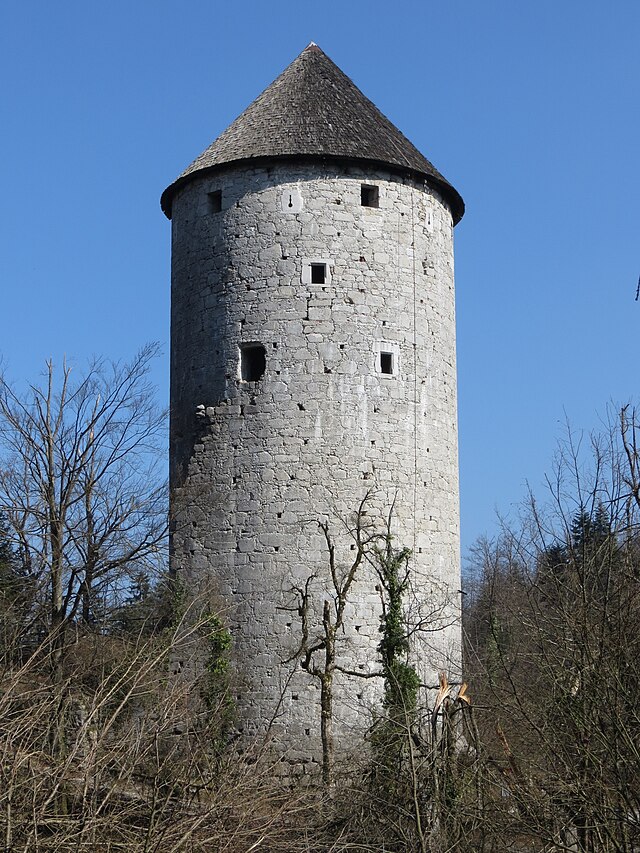
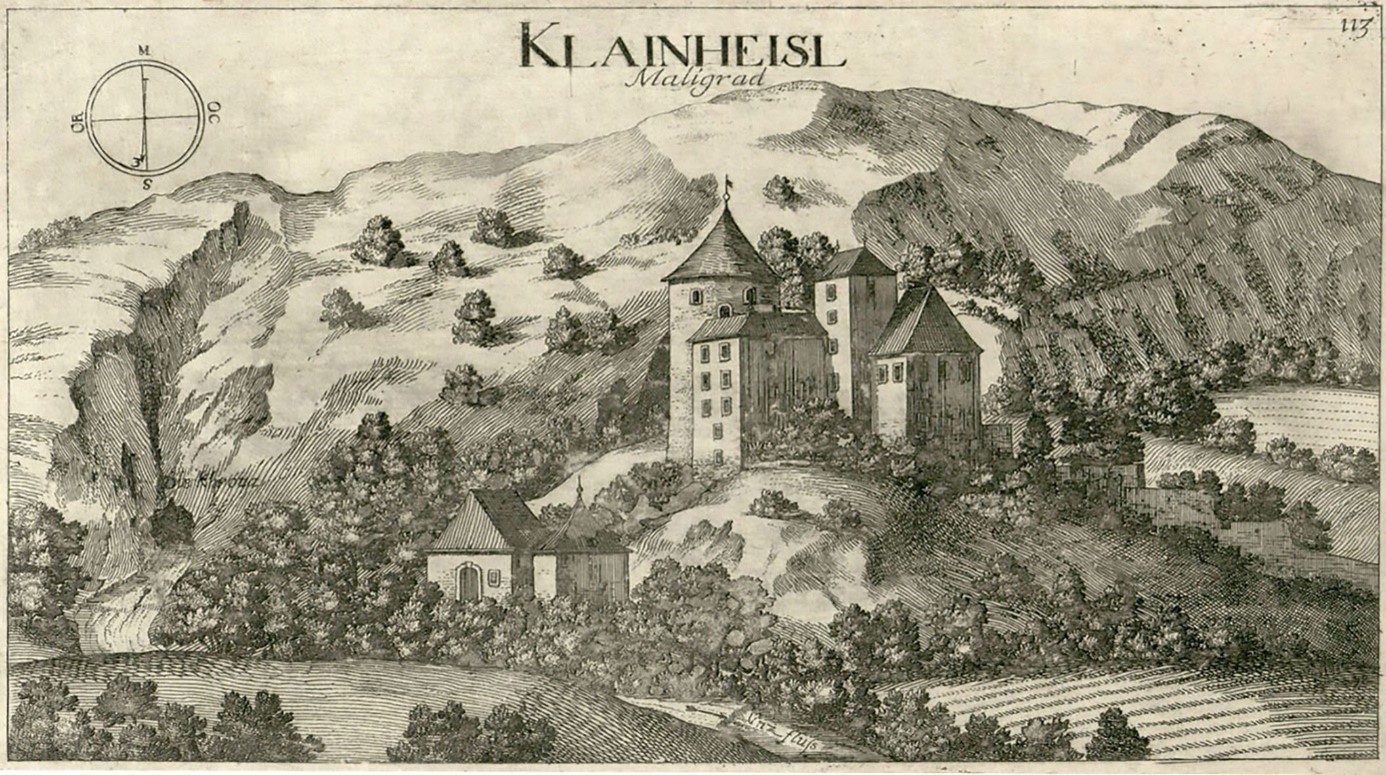
Of the former castle complex, only the round tower (the medieval Bergfried), also known as Rauber’s Tower, has been preserved. From the ruins and the shape of the terrain, as well as historical depictions, it can be deduced that next to the tower there was a group of lower, two-storey buildings with living quarters and a castle chapel. The floors were divided by wooden ceilings and connected by wooden stairs. In the castle chapel, a star-shaped vault has been preserved, which art historians attribute to the Late Gothic period in Slovenia. The vault is “carried” by geometric consoles that are decorated with the coats of arms of both families of the spouses Niklas Rauber and Dorothea Lueger. The two portals on the tower are also important Late Gothic monuments. The first is located on the ground floor and is semicircular, with its edges cut in the shape of a buckwheat grain. The second portal is located on the first floor, has a flat lintel, and Late Gothic ears.