Description
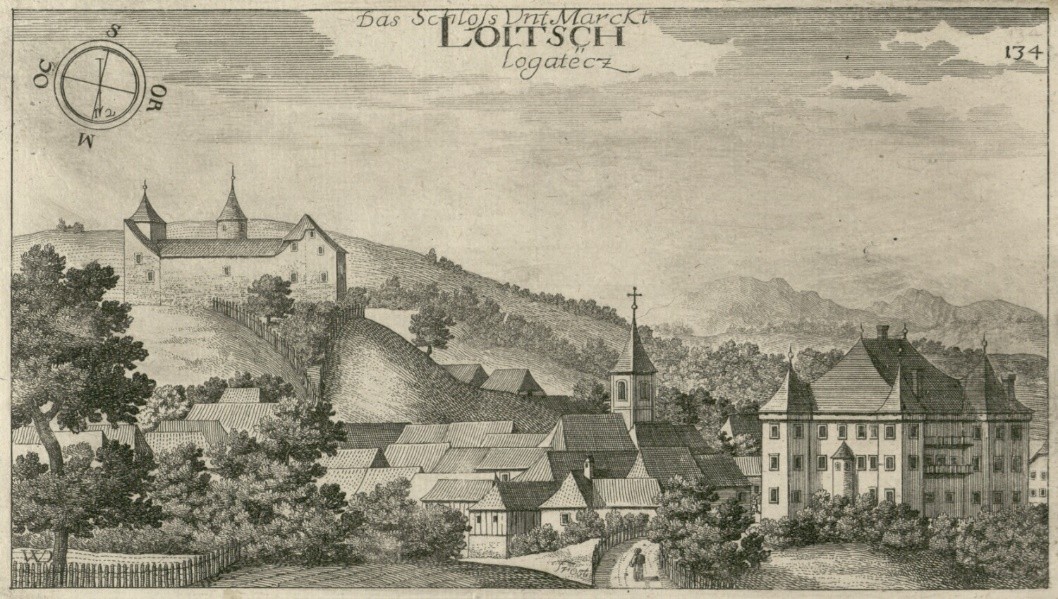
The manor is located along the main road in the old centre of Gornji Logatec (Upper Logatec). Sources from the late 15th and 16th centuries mention the building as the seat of the Governor’s Office. Since it was an office of the ruler of the province, the competent authorities leased it, and numerous families are mentioned among the leaseholders: Scheyer, Thurn, Scheir, Hoffer, Ainkhürn, Serenitz, Zobl, and Moscon. The last, Adam Moscon, who also held Ribnica as a lease, later became the first owner of the Logatec Domain. After his early death, it was managed by his widow, Maria Saloma of the Edling family. Since Maria Saloma married Ehrenreich Lamberg, the domain passed to him, but he handed it over to Moscon’s heirs in 1620.
As a widow, Maria initially opposed the sale of the Ribnica Domain, believing that the payment of her dowry and inheritance was tied to the estate, which her late husband had only leased. All subsequent owners who purchased the domain and the manor until the end of the Second World War — the Eggenbergs (after 1620), the Cobenzls (1716), the Coroninis (1810), and the Windischgrätz (1846) — were also owners of Haasberg Castle near Planina. After 1945, the manor housed a youth education institution for several decades.
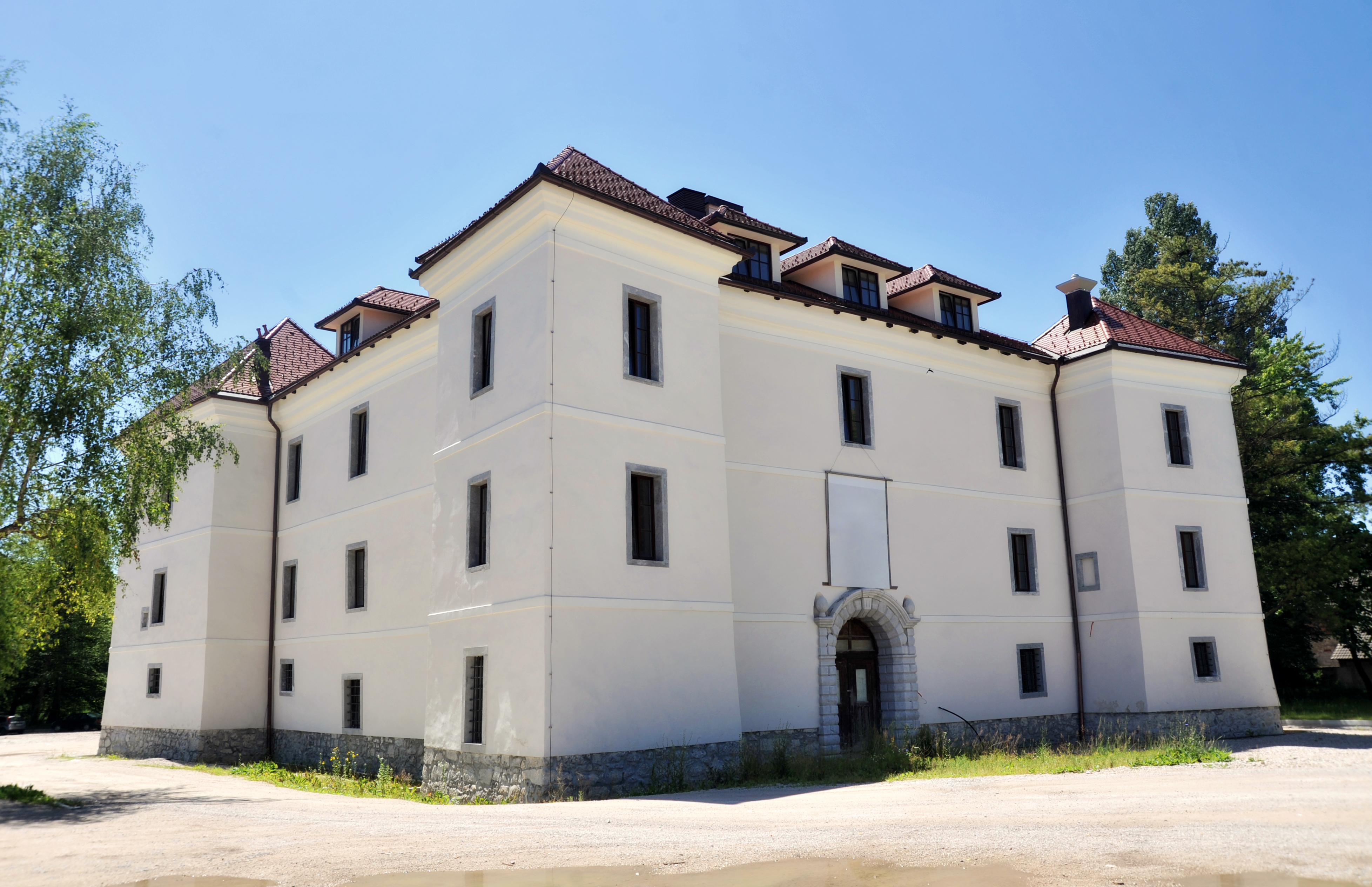
The manor was originally a building with a simple rectangular floor plan and one storey, located in the eastern part of the later building. At the end of the 16th century (around 1590), Urban Ainkhürn had it rebuilt into a Renaissance mansion with wedge-shaped corner towers. It is the first such Renaissance manor in Slovenia, and its architecture is similar to the mansions of Kromberk, Rubbia, and Dobrovo (the latter in the Goriška Brda region), which are also part of the itinerary.
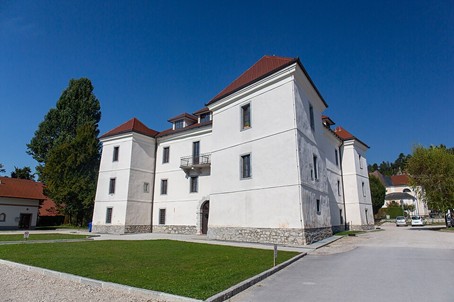
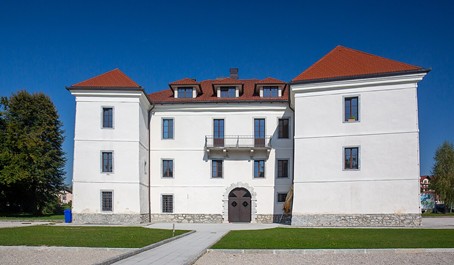
The Renaissance manor had a rectangular floor plan with pronounced corner towers extending out of the axis of the plan. Not all of these towers are identical; the north-eastern tower is slightly wider than the others. The architecture is divided into horizontal bands or storeys with rectangular and square windows, as well as a profiled cornice. All four façades repeat this design, with bricked-up windows visible on the narrow sides of the corner towers. The exceptions are the northern and southern façades, which feature portals and a balcony.
Unlike the other manors of the same type in our itinerary, a thorough renovation of the manor — this time in the Baroque style — took place in the first half of the 18th century, as Johann Caspar Cobenzl renovated all the manors he bought, as well as some he already owned. On the north side, the Baroque main portal with a rustic semicircular finish and a pointed edge has been preserved; it is related to the portal of the Hošperk Mansion. The manor was probably renovated according to the plans of the Baroque architect Carlo Martinuzzi, who also designed the renovations of other manors for Cobenzl. The southern portal, located on the side of the former park, is therefore less representative. The balcony on the second floor of the southern façade, resting on four consoles, also overlooked the park area. Part of the park next to the manor has been preserved; it was certainly much larger in the past and stretched southwards, towards where the Vitez Castle Park stands today.
The interior of the manor is symmetrically arranged. The ground-floor rooms have tub-shaped vaults, while the ceilings on the upper floors are wooden and plastered. The floors are connected by a two-flight winding staircase.