Description
The remains of the manor (or mansion) are located on the site of the medieval Ribnica Castle. The medieval castle was built in the second half of the 13th century, when it was owned by the Counts of Ortenburg, and after them it was inherited by the Counts of Celje for only a few decades (1420–1456).
After the extinction of the Counts of Celje, it passed to the Habsburgs, who leased it to various noble families. The history of its owners is extremely varied and interesting. The first were the brothers Georg (II) and Andreas Lamberg. Georg served in the army of Emperor Frederick III in the war with his brother Albrecht. He lived to the age of ninety-nine and left many children, as he married Magdalena Thurn even at the age of eighty; she bore him ten sons and four daughters. Among the later tenants of the domain was also Kaspar Rauber (who also held Mali Grad in Planina, part of this itinerary, as a lease).
Since the castles belonging to the Habsburgs were often leased as payment for services, the tenants changed frequently. Among them we should mention the knight Bernardin Ritschan, who took part in the defence of Vienna against the Turks and was granted a lease of the domain for a short time in 1521. During the rise of Protestantism, Ribnica Castle became a centre of the Protestant faith. Lutheran preachers conducted ceremonies in the castle chapel, which were also attended by serfs, and Primož Trubar occasionally visited the castle. After several tenants, including the Galli, the domain was leased to the Moscons (1579), who were well-known money-lenders to Archduke Ferdinand at the time. As various members of the family held numerous manors in lease, they immediately sublet it, as true entrepreneurs that they were. A contract concluded by a Moscon with a tenant is of interest, as it stipulated that a special room in the castle must always remain available to him.
The first owner after the long series of leaseholders was Johann Jakob Khisl, who, as a sign of his conversion from Protestantism to Catholicism — which was inevitable in that time and place — founded the later very famous pilgrimage church of Nova Štifta. The noble Trillegkh family bought the domain from him in 1641. Since the area had not been exposed to direct incursions by the Ottoman army for some time, its transformation from an anti-Turkish fortress into a comfortable residence of the wealthy nobility began.
Also of interest is the story of the last representative of the Trillegkh family, Anna Katharina (1688–1724), who, at barely fourteen years of age, married her father’s cousin Ludwig Gundaker, Count of Cobenzl (1678–1745) in February 1702. The marriage had to be approved by both the Pope and the Emperor, as marriages between such close relatives were otherwise forbidden. Johann Caspar Cobenzl used his influence to obtain permission and thus secure the family’s inheritance of the Ribnica Domain, as the divorced mother had left the guardianship of her daughter to her influential relatives, the Gallenbergs. The couple had no children and mainly lived at the Štanjel Manor on the Karst Plateau and the Lože Manor in the Vipava Valley. Anna Katharina died at the age of just thirty-six.
In the late 1730s (1738), it was bought from Ludwig Cobenzl by his brother Johann Caspar Cobenzl and handed over to his younger son Guido Cobenzl upon his marriage. The income from the domain was to provide him with a decent living. In 1810, Philip Cobenzl sold the Ribnica Domain to his tenant Anton Rudež, who was originally a serf of the Štanjel Domain from Kobjeglava on the Karst Plateau. Although there are many unverified and probably false claims, the Ribnica Domain was the only manor that Philip Cobenzl sold shortly before his death. Anton Rudež was a classmate of Valentin Vodnik at grammar school, and he also collaborated with other Enlightenment-minded intellectuals. The family retained the domain until 1937, when the Rudež family sold the castle to the state and emigrated abroad, taking with them all the castle’s interior furnishings.
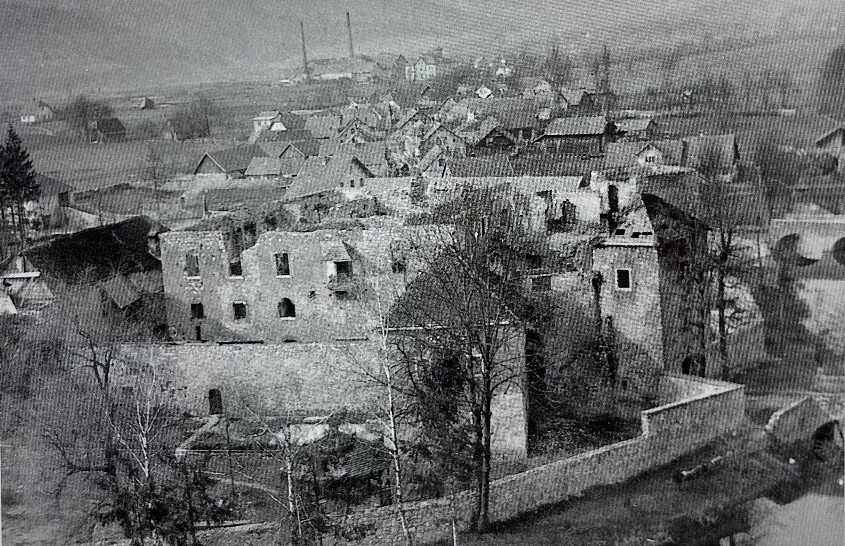
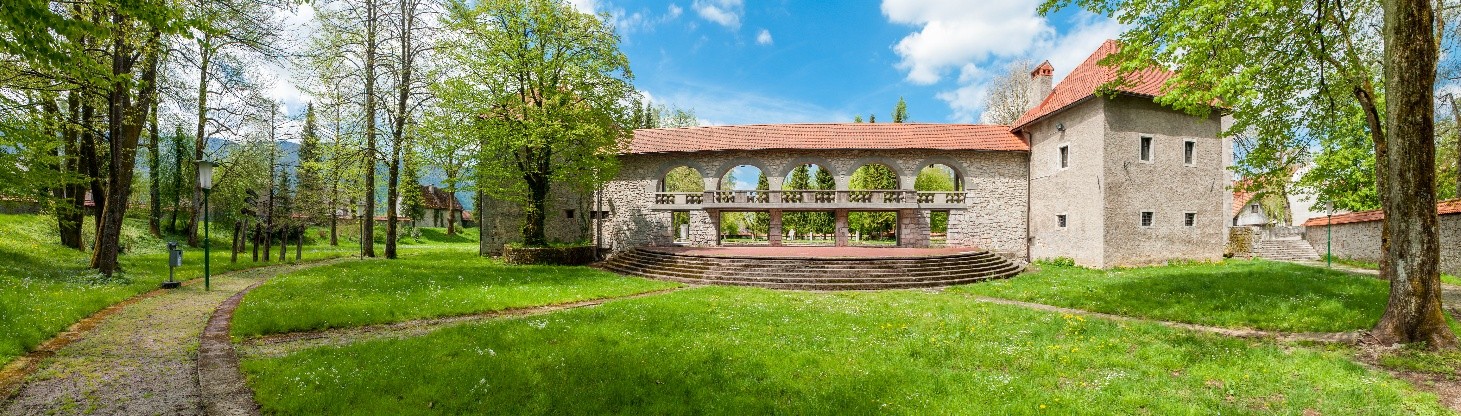
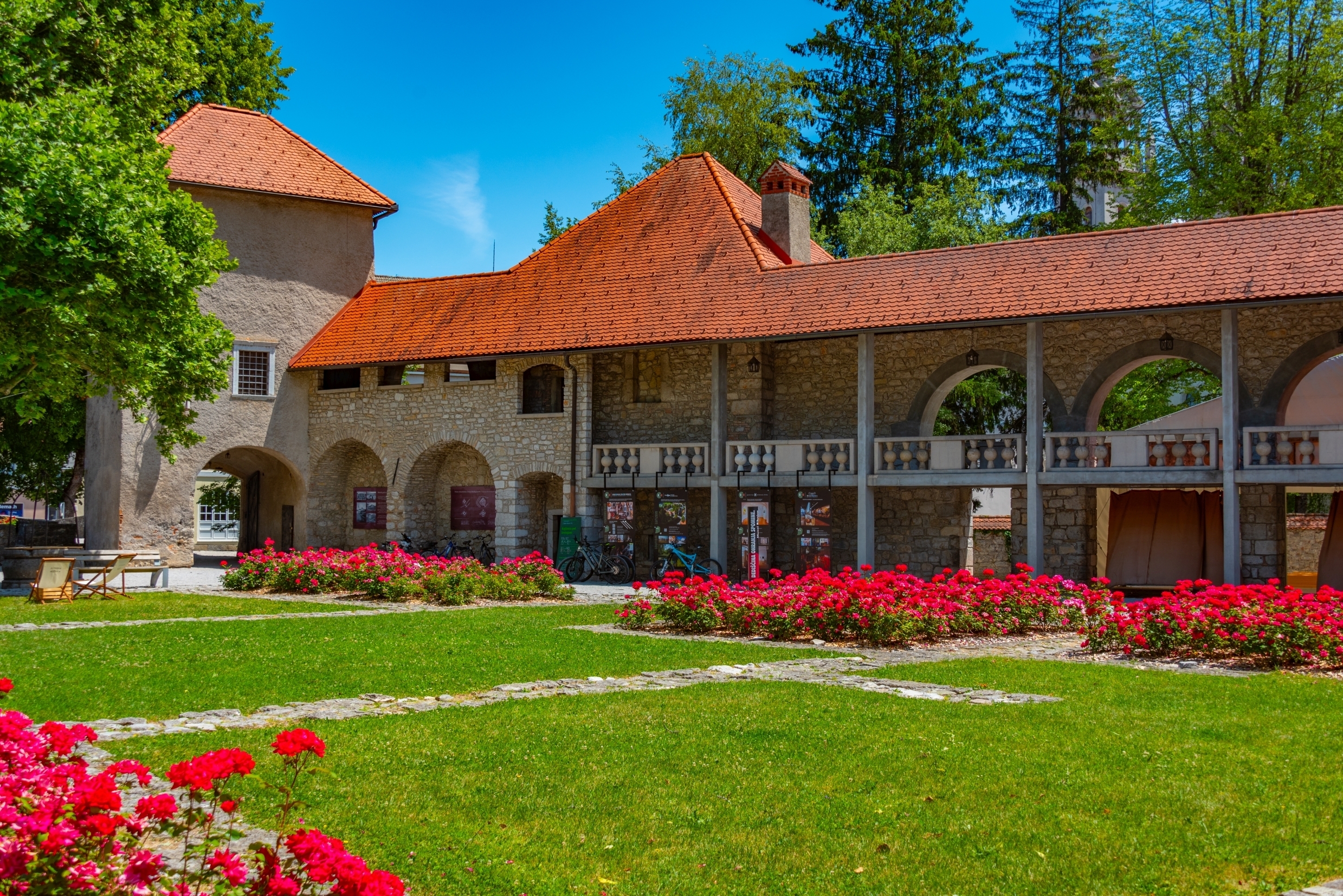
In 1944, the core (but not the walls) of Ribnica Castle was burned down by the VOS (Security Service), and in 1950, the well-preserved part of the castle was ordered to be demolished. A decade later, adaptation work was carried out on the remains of the castle, giving it the appearance it has today.
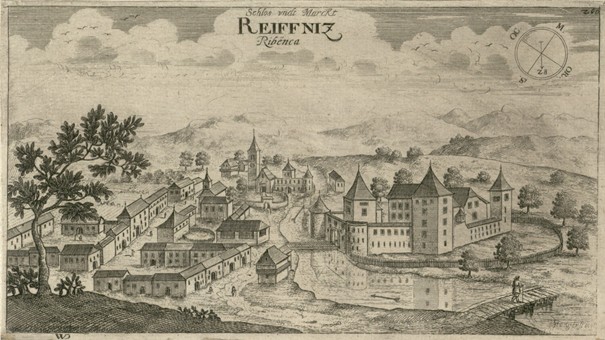
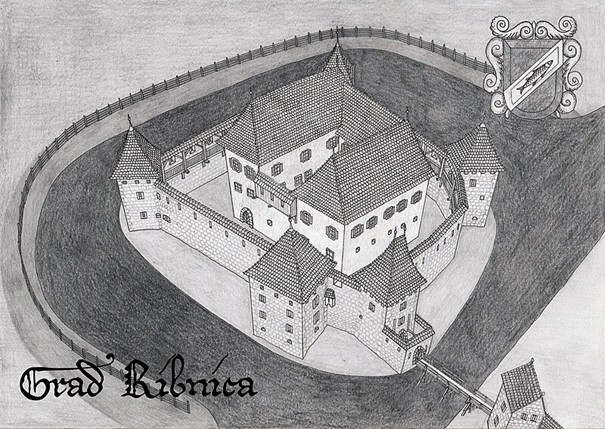
Due to the flatland location of the castle, the building was protected by thick walls, with the entrance to the castle complex on the south-eastern side. Researchers assume that despite its lowland position, it was probably not surrounded by a moat and therefore did not belong to the rather rare water castles. In its oldest phase, the castle core had two floors and a rectangular ground plan. The façades were dotted with simple rectangular windows. Presumably, the living rooms and the knights’ hall were on the second floor of the residential part, where there were also larger windows.
The castle underwent its first expansion with a new residential section before the 15th century. The connecting tract most likely contained auxiliary rooms and a castle chapel. After two fires in the 15th century, the castle was only repaired and did not undergo major architectural changes. It was probably already in the late 15th century that it received a counter-Turkish fortification — for example, an extremely thick polygonal outer wall with square towers — due to the proximity of the Ottoman Empire and frequent incursions by Ottoman militias. The tenants at the time obtained permission and funds for construction. The castle complex also served as a refuge for the inhabitants of the market town of Ribnica.
In the 17th century and under different ownership, the castle was gradually transformed from a counter-Turkish fortress into a luxurious Baroque residence. The inventory of Georg Andreas Trillegkh’s property reveals that after the renovations, the two bedrooms in the castle were particularly luxurious, including those of his then divorced and estranged wife Susanna Felicitas, née Gallenberg. Both had semi-silk wallpaper and other items of Baroque luxury: paintings, a mirror, and a wall clock. The dining room, as the central space, served as a reception room for guests, with seven paintings and Venetian leather wallpaper.
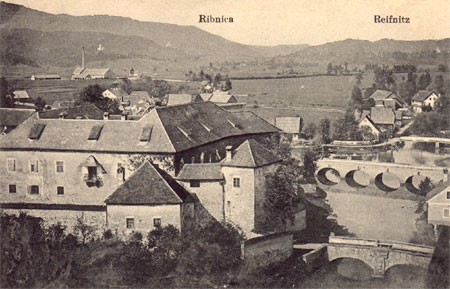
Since the castle was quite remote, guests could sleep in a luxurious room intended only for them. The wooden bridge — later replaced by a five-arched stone bridge, today the so-called French Bridge — was certainly already in place before 1678. The wooden drawbridge in front of the entrance tower was replaced by a fixed wooden bridge in 1715. Guido Cobenzl baroquised the castle chapel and commissioned a new altarpiece, painted by the Baroque painter Valentin Metzinger (1699–1759). Since the castle was badly damaged in a fire in 1778, Guido renovated it in a rational manner, as he did not wish to spend too much on the works. Anton Rudež was the last to remodel the castle (after 1815), for example, the main castle portal on the entrance tower.
Before its destruction in the Second World War, the concentrically designed castle complex consisted of a castle core, outer defensive walls with various attached buildings, and a high garden wall that enclosed a roughly oval ground area with a diameter of approximately 120 to 140 metres.
Address
Activities
Map