Description
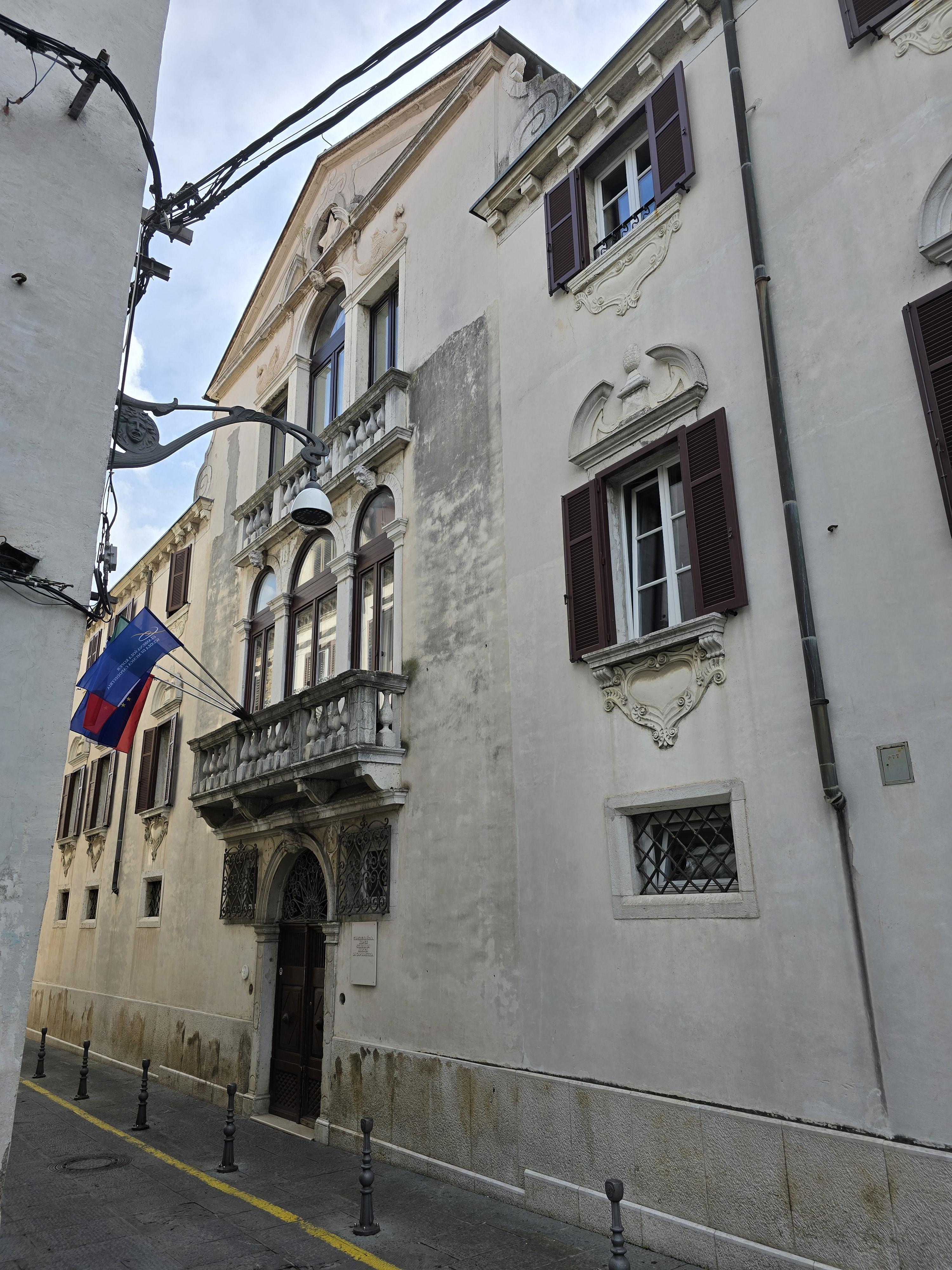
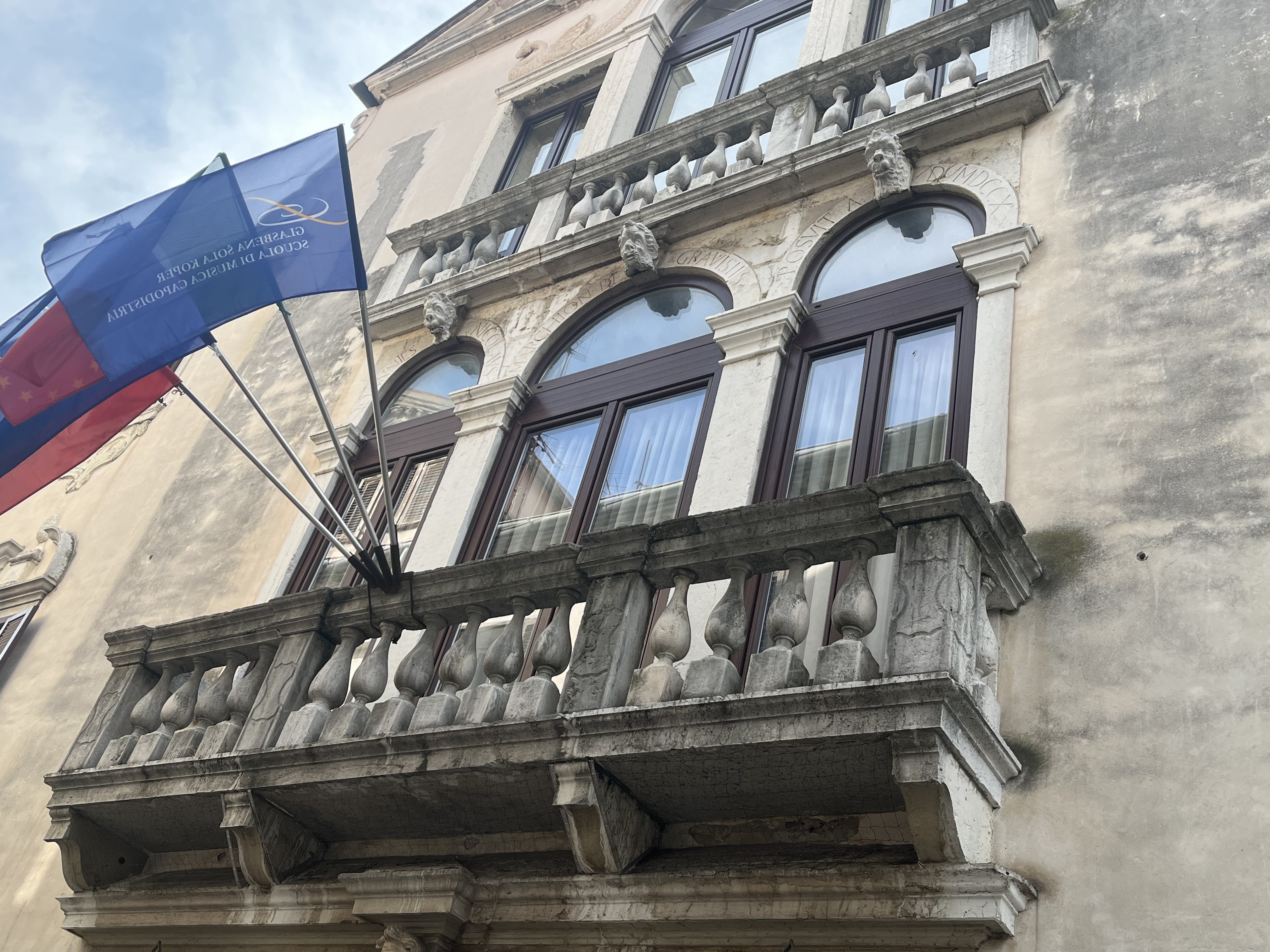
The Gravisi–Barbabianca Palace was the main residence of the Gravisi family in Koper, located between Gallusova Street and Brolo Square. The importance of the family is also reflected in the rich, representative appearance of the exterior, the palace being the most important Baroque palace in Koper. It acquired its current appearance after renovation in 1710, as evidenced by the inscription IOHANNES NICOLAUS MARCHION DE GRAVISIIS POSVIT A.D. MDCCX. The palace has three floors, the central part of the façade is highlighted by a portal, two balconies and triforas and a triangular finial. The portal and triforas are decorated with stone lion heads, a common decoration of façades in the Baroque period. Additional decoration of the Marquises’ Palace includes the window decoration, the roof cornice and volutes.
The interior has an entrance hall, from which a staircase leads to the noble hall on the first floor. The staircase is adorned with preserved sculptural decoration on the ceiling and two of the three statuettes on the balustrade – symbols of architecture and painting – while the third, which symbolized sculpture, has been lost. The staircase of the Gravisi–Barbabianca palace was also decorated with portraits of Nicolò and Leandro Gravisi and Giann’Andrea Barbabianca, complemented by equestrian portraits of King John III of Poland, Emperor Leopold I, Duke Charles V of Lorraine and Prince Eugene of Savoy. Their choice emphasized the cosmopolitan prestige and clear support of the Gravisi family for the Habsburg ruling house when the palace was renovated in 1710, since it was precisely these great men who personified the European struggle against the Turks after the victory at Vienna in 1683. Today, the portraits are kept in the Koper Regional Museum and in the Piran unit of the Institute for the Protection of Cultural Heritage of Slovenia. The original decoration of the hall on the noble floor (piano nobile) has been preserved. The ceiling painting was added in the 19th century. Today, the palace houses the Koper Music School.
In the second half of the 18th century, the male line of the family became extinct. With the marriage of Chiara Barbabianca (1745) to the Enlightenment scholar Girolamo Gravisi, the entire family domain passed into the hands of the Gravisi family, which is why the palace still bears the names of both families today. This palace played an important cultural role, as in 1739 Giacomo Gravisi and his cousin Gian Rinaldo Carli founded the Accademia degli Operosi, a centre of Enlightenment thinkers in Koper. The academy encouraged creativity, industry and reason, and focused its activities on literature, historiography and philosophy, and sought to spread the ideals of the Enlightenment.
On the eastern edge of Prade, formerly a hamlet of Bertoki on the road to Pobegi, stands the abandoned Almerigotti Villa, later owned by the Gravisi and Scampicchio families, known to locals as the “Gravisi Castle.” Construction was begun by the Almerigotti family in the first half of the 16th century. The complex consisted of a long one-storey residential building with an attached outbuilding, a large walled courtyard on the north side, and a tower at the north-west corner, which served as a dovecote. At the north-east corner of the courtyard stood the chapel of St. John the Baptist, which took on Baroque outlines around 1700 and, according to Paolo Naldini, grew in 1556 as a patrimonial right of the Gravisi family. The façade of the residence was emphasized by a rustic stone portal and window frames of Renaissance forms. During World War II, the building was used as the headquarters of an agricultural cooperative, and later became private property. Today, only the partially demolished residential building, fragments of the walls, the buried ruins of the outbuildings and the chapel of St. John the Baptist, the remains of which are visible along the main road, have been preserved. The former courtyard platform is completely overgrown, and the tower at the corner is preserved only in its lower part.
In addition, the Gravisi family owned one of the largest residences in the Koper hinterland – the Gravisi Barbabianca Villa on the Šantoma Hill near Škocjan, which is unfortunately now demolished. In 1943, the central part of the building was destroyed by fire, and by 1990 the once luxurious complex had turned into a ruin and passed into private ownership. The eastern walls of the residential building have been preserved today, and the southern five-storey garden on the walled lower terrace, which is now demolished, has been completely renovated. A smaller Gravisi family villa has been preserved near St. Stephen, between Šalara and Gažon. In Semedela above Koper, the doctor Pio, Marquis of Gravisi, built the Gravisi Castle in the neo-Gothic style between 1885 and 1887, which imitated the appearance of medieval fortresses with its turrets. During the two World Wars, it was raised by one floor according to the plans of Errore Fondo, and surrounded by a stone wall that imitated the appearance of medieval walls. After the Second World War, the castle was nationalized, used as a residential complex, but due to poor maintenance it began to deteriorate – until 1992, when it was completely restored.
The castle and fiefdom of Petrapilosa holds a special place in the history of the Gravisi family. The ruins of this mighty fortress still stand today on a hill overlooking the Bračana Valley near the hamlet of Mali Mlun west of Buzet (today in Croatia). The castle came into their possession in 1440, when the Venetian Republic awarded it to them as a reward for military merit, and it remained in the family for almost 450 years, until 1889. The fiefdom included twelve villages, which brought the Gravisi significant income and thus economic power and social influence.
Address
Activities
Map