Description
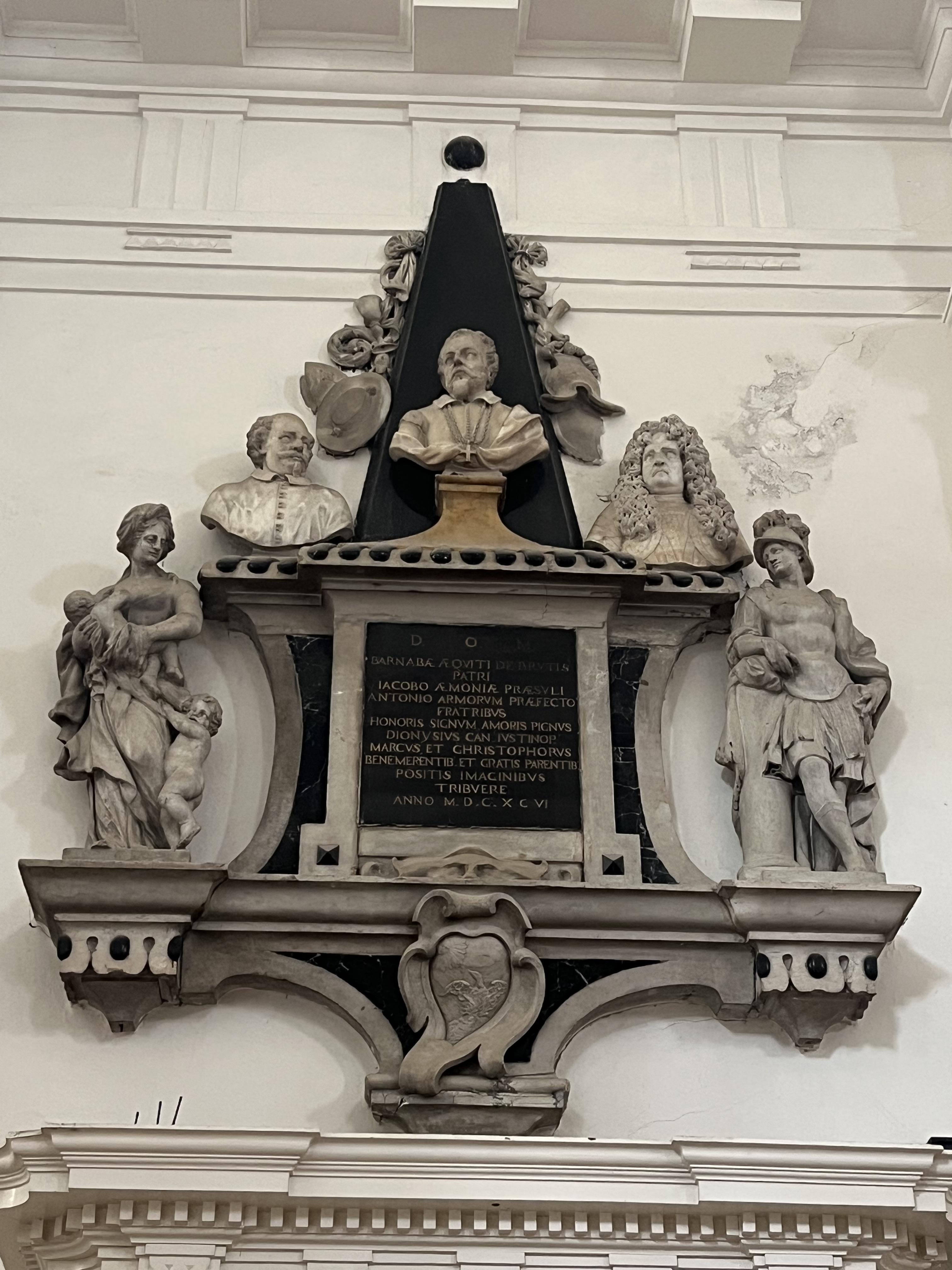
The Bruti family originated from Ulcinj in present-day Montenegro, but moved to Koper due to Turkish invasions in the 16th century. In 1575, it was admitted to the Grand Council, after which the family produced a bishop and several dragomans in Istanbul. In the 18th century, they also performed military functions. The family became influential through prudent marriages, managing to exploit both social capital and wealth.
The political rise of the Brutis was officially confirmed by a Doge’s decree of 3 September 1575, which admitted the Bruti brothers and their legitimate male descendants to the nobility of Koper and praised their father, the knight Antonio Bruti, for his many years of loyal service to the Venetian Republic. The process of admission to the Koper nobility was not without complications, as the city’s Grand Council protested against this violation of the local statutes, but in the end the will of the Venetian authorities prevailed. In the following decades, Giacomo established himself as an important citizen: in 1583, he became an ambassador in Venice, and later Captain of the Slavs – commander of the Koper rural army. These functions consolidated the family among the city’s elite.
The story of the Bruti family also had dramatic episodes. Giacomo’s brother Bartolomeo, who trained for a short time as a Venetian interpreter in Istanbul, joined the Spanish secret service, organized a high-profile prisoner exchange, and later entered Moldavian politics before dying a violent death in 1592. After trying to escape, he was arrested, then mutilated and strangled, and his body thrown into the Dniester River. While this was happening, his relatives in Koper were expecting, from March 2 onwards, that he would “return home in a few days.”
The Bruti family also produced a Bishop of Koper, Agostino Bruti (1668–1747). After entering the Dominican order, he studied theology in Padua, one of the main educational centres of the Venetian Republic. He first served in Koper as an advisor to the Inquisition and later in Rome as a secretary to Venetian diplomats, where he established important contacts and became Grand Chamberlain of Pope Clement XI. He subsequently became the prelate of the Dominican abbey in Asola, then titular bishop of Crete, and in 1733 was appointed Bishop of Koper. During his thirteen years of leading the diocese, he convened two synods, enlarged the seminary, and continued the Baroque renovation of the cathedral. His remains are buried in the rotunda of St. John the Baptist in Koper.